



CORPORACIÓN HUMANAS
By: María de los Ángeles Ríos Zuluaga.
The Committee promotes the inclusion of the gender perspective of the Peace Agreement in territorial plans, achieving 47 measures in Sucre and Bolívar. Today, it is promoting their monitoring and implementation.
The Committee for Monitoring Gender-Based Measures in Montes de María was created on March 18, 2021 to analyse the implementation of the gender approach of the Final Peace Agreement (AFP), incorporating a territorial and ethnic perspective. Since then, it has produced two reports that confirm the slowdown of the implementation of the Agreement and, with it, the difficulty of overcoming the impacts of the armed conflict on women’s lives. Among the causes of the slowdown are: officials’ lack of knowledge about gender-based measures and the weak coordination between the national and local levels.
It is possible to implement
the Peace Agreement’s gender
approach from the territories,
using local policies and programmes.
During 2023 and 2024, women leaders promoted the territorialisation of these measures through their inclusion in the Territorial Development Plans (PDT). This strategy was based on an understanding of the territory as a network of relationships between people, nature and the institutional, economic and organisational conditions that structure them1. It was done by means of the recognition of and action on existing spaces of power (mayor’s offices, governor’s offices, councils and assemblies), linking with institutions through informed participation that included educational actions to address ignorance of the gender approach, and articulating the goals of the PDT with gender-focused measures. It also involved challenging the cultural meanings that have historically limited who can speak, how and about what, thus reaffirming women’s right to influence decisions that affect their territories.
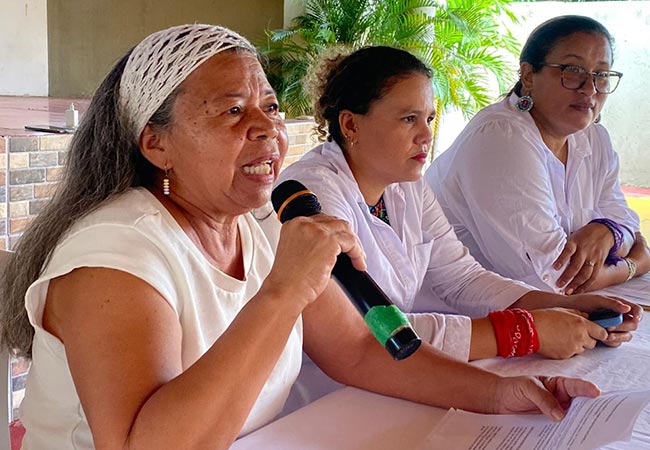
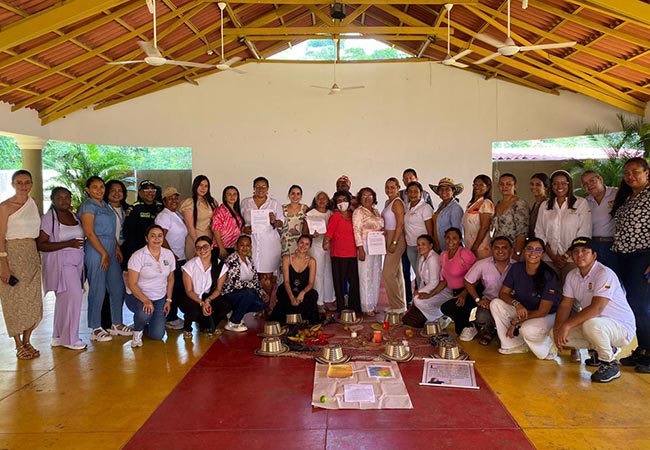
The participatory processes for formulating the PDT are key spaces for ensuring that citizens can make suggestions to overcome the problems that affect them.
The women leaders implemented this strategy in four stages. 1) Analysis of the PDT development process, 2) identification of opportunities for advocacy, 3) development of an advocacy agenda based on women’s issues, 4) implementation of advocacy actions. This was implemented in municipalities in Sucre (Sampués, San Antonio de Palmito, San Onofre, Sincelejo and Morroa) and Bolívar (El Guamo, San Juan Nepomuceno and Cartagena), as well as in the departmental plans of both departments.
The scenarios and actors that the women of the Committee identified as key to achieving the incorporation of gender measures were: public hearings for the construction of the PDT, Territorial Planning Councils, government advisory teams, council sessions and assemblies. In all of these, women submitted their proposals.
The women of the Committee participated actively in these spaces despite being discredited with expressions such as “you don’t know how to read,” “that word is not pronounced like that,” “you need to dress appropriately for the occasion,” and “here they come again to cause trouble.” They succeeded in incorporating 56 provisions into the PDT, which will implement 47 gender-focused measures, including:
25 measures from Point 1. Comprehensive Rural Reform, aimed at guaranteeing priority access for landless or land-poor peasant women through: access to productive factors (land, housing, financing, technical assistance and training), the formulation of a public policy with an ethnic focus for black and indigenous women, and the creation of viable productive projects for women entrepreneurs.
18 measures from Point 2. Political participation, consisting of actions that strengthen women’s participation in decision-making processes through: the creation of specific mechanisms to guarantee their voice in consultation forums, the formalisation of women’s advisory councils, leadership programmes in rural areas and the strengthening of Municipal Women’s Offices.
4 measures from Point 5. Victims, focused on rebuilding the social fabric with a gender perspective through: the creation of listening centres for women, comprehensive programmes for victims of violence, and the institutionalisation of the “Women’s Week” as a space for memory, participation and symbolic reparation.
The experience of the human rights defenders of the Montes de María Committee shows that it is possible to advance the implementation of the gender approach of the Peace Agreement from the territories, taking advantage of existing local policies and programmes, without the need to create new instruments. The inclusion of these measures reveals that institutional coordination, women’s participation and recognition of territorial dynamics are essential for building territorial peace.
The active participation of women
leaders was key to territorialising
the gender approach of the
Peace Agreement and strengthening
its implementation.
The Committee is currently in a new phase focused on monitoring the implementation of the measures incorporated, with the aim of translating them into concrete actions that transform women’s lives. To this end, it is essential to strengthen capacities, promote institutional and cultural transformations, and maintain spaces for dialogue and citizen oversight.
- Edwin Murillo and Angelica Bernal, Territorialization as a proposal for public policy analysis, Journal of the University of Zulia, 2024, p. 407.