



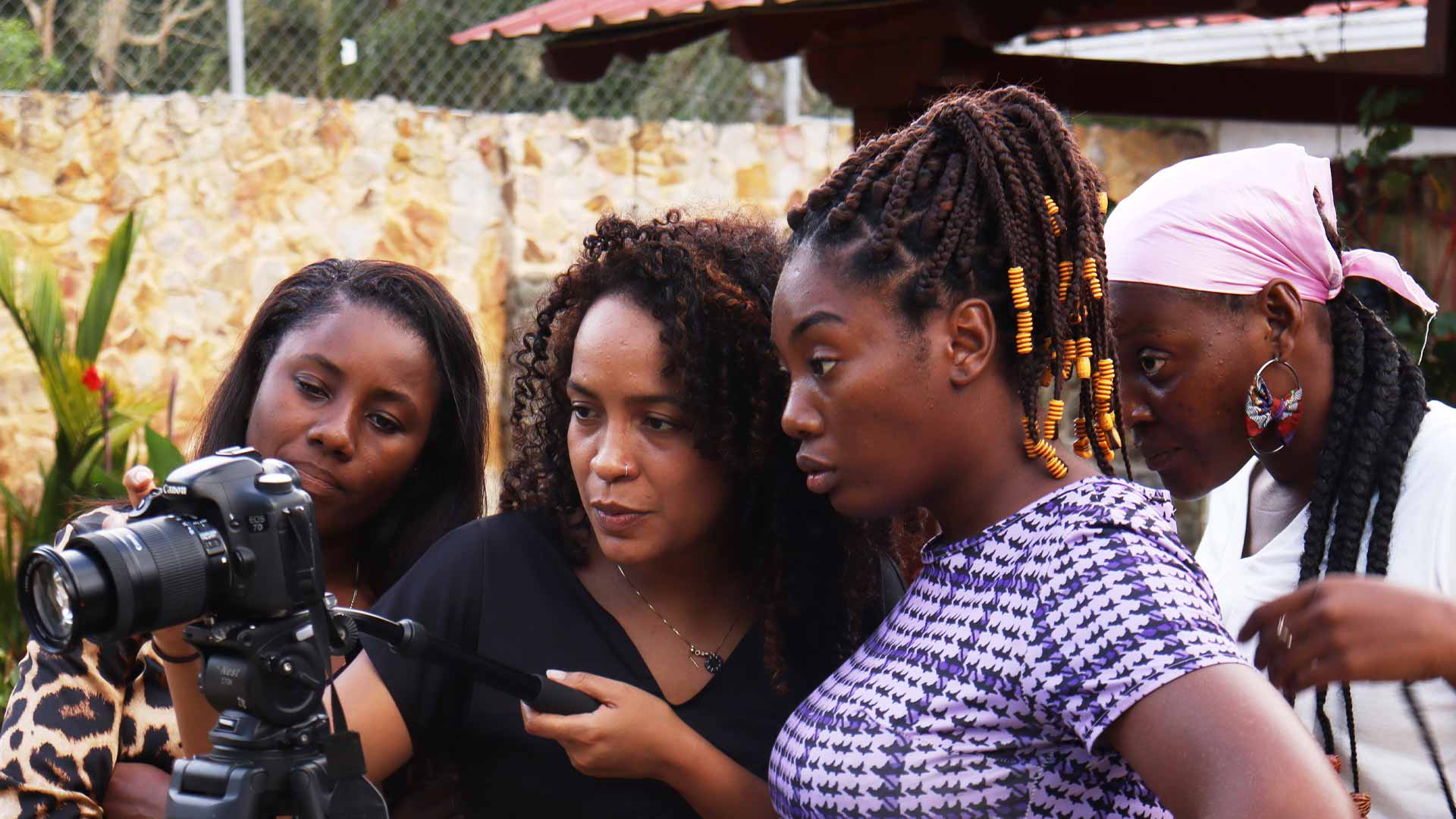
Periscopio Invertido (The Inverted Periscope), as a chronicle, revives memories and resistance from the margins of Colombia. It uses documentary film as a tool for denunciation and collective creation that leads towards other possible futures.
THE NEED TO LOOK FROM BELOW
Periscopio Invertido emerged in Colombia from a murmur of the conch shells in the centre of the continent, which spoke of the need to learn to see beneath the earth in order to find the buried key to memory and use it to heal the peoples afflicted by the plague of oblivion. We travelled along trails and paths, fumbling through the long night. We listened to the voices of the elders and the song of the fish. We saw a multitude of fireflies illuminating the grey streets and hundreds of grasshoppers that, without exhausting their strident sound, united into a single voice.
Then Periscopio Invertido emerged: the School of Memory and Audiovisuals. It’s a part of the urgent need to maintain the search for the struggles and resistance that lie beneath the earth. The school focuses on the perspective of women, young people and gender dissidents. It emerged as a device for remembrance, as an attempt to reverse the gaze, to look inward. Fragments of the country’s reality are narrated from the margins, the suburbs and the territories.
THE JOURNEY OF PERISCOPIO INVERTIDO
Each version of Periscopio Invertido builds a theme of memory that functions as a compass in the midst of the thicket of the Colombian conflict. To look back on this initiative is to undertake a historical, political and cultural review of Colombia through the lens of memory.
The first version was made in 2011 with young people from the village of San Juan del Sumapaz, focusing on the conflict over land and peasant identity. This gave rise to the documentary Al páramo lo que es del páramo (What belongs to the moorland stays in the moorland), which shows the defence of the territory against the geopolitical interests of megaprojects that threaten vital resources such as water and the cultural practices that surround it.
In 2012, the school arrived in the La Perseverancia neighbourhood of Bogotá. This gave rise to Perseverancia: territorio de maíz, chicha y dicha (Perseverance: land of corn, chicha and joy). It explores the history of this neighbourhood, its peasant and working-class roots, its ancestral relationship with chicha and its leading role in the Bogotazo, following the assassination of Jorge Eliécer Gaitán in 1948.
Periscopio Invertido is a
historical, political and cultural
review of Colombia through
the lens of memory.
In 2013, Periscopio Invertido produced three 3-minute films. One that denounced the political genocide against the Patriotic Union (Esa rosa se llama UP), one that reflected on death in violent times (Rito a la muerte) and one that narrated the despair inherited by a generation (Caminando). Between 2014 and 2015 it addressed forced disappearance and “social cleansing” with Nomen Nescio, the role of the media in depoliticization with Última Hora, and the grief of those searching for their disappeared loved ones with Bruja.
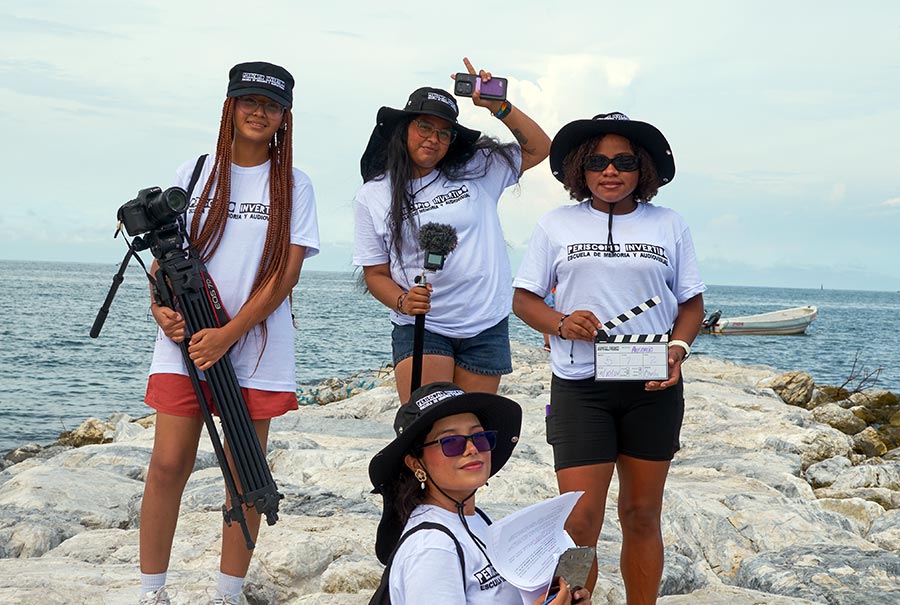
THE IMAGE AS A REFUGE FOR MEMORY
In the last decade, Periscopio has shifted its focus from acts of violence to memories of resistance. These are stories of transition, crossroads and possible paths that communities trace in order to build peace and demand guarantees of existence. The aim is not to tell a single truth, but to show that each image leads to another, like someone walking along a spiral. Sometimes to illuminate possible worlds; other times to remember those that were taken from us.
This political-educational device is based on the conviction that popular communication and audiovisual media are tools for inhabiting the present with the potency of the past. The productions are configured as collective exercises in memory that invert the hegemonic logic of narrating history and give rise to other ways of telling stories from a place of pain, dignity and hope.
CURRENT CHALLENGES AND POSSIBLE HORIZONS
Each version of the school proposes ways of living together as part of the reconstruction of a fabric torn apart by years of violence. Periscopio Invertido is a way of sharpening our gaze and, through the lens of memory, sketching out paths for the future. It enables action through the moving image, thus strengthening the intersensibilities of resistance as a basis for the creation of other possible futures.
Periscopio enables the strengthening
of the intersensibilities of
resistance as a basis for the creation
of other possible futures.
Today, faced with the resurgence of narratives of fear, the silencing of social processes and territorial dispossession, the challenge is to continue narrating. To remember not only to remember, but to transform.
Periscopio Invertido is a call to continue building the country from the bottom up, with hands full of earth, images and dignity. That is why today we dream from the regions. In recent years this project has flourished in territories such as La Nupa, Tumaco, the Pacific corridor and the Colombian Caribbean. From there, memory remains alive and in motion.
LINKS TO ARTICLES
Murmullo de la montaña
Periscopio Invertido: Memory and Audiovisual school. Dissidence, Transitions, and Re-existences: Otherness in Peacebuilding.
Nomen
Nescio
Short film produced as part of Periscope Inverted: School of Memory and Audiovisuals. It seeks to reveal the phenomenon of disappearance in the urban setting…
Cuerpos en guerra
Periscopio Invertido: Memory and Audiovisual school. Dissidence, Transitions, and Re-existences: Otherness in Peacebuilding.