



The armed conflict in Guatemala had negative effects on the lives of the population, mainly on the Maya. However, there are people who, through their transmutation, contribute to the well-being of others.
The internal armed conflict in Guatemala left multiple scars on the lives of those who lived through it and on the new generations who still suffer some of its effects. However, there are people with powerful missions who, from their very being, contribute to the well-being of others and of the great web of life. This is the case of Sara Q, who represents the journey of numerous women who have participated in training programmes as social therapists at Mujeres Mayas Kaqla. Through their new perspective and awareness, they are transforming their own lives and bringing about profound changes in the lives of other women and their communities.
Sara’s most special memory is of her home, which she had to flee during the internal armed conflict in Guatemala (1960-1996). “There lies the hill of my grandfather Mam Aj’. I remember my grandparents climbing the hill to celebrate community festivals, burning pom and lighting candles. My grandmother was a midwife and delivered my mother. We were 12 children, and this is part of my identity.”
During the armed conflict, it is estimated that more than 200,000 people died or disappeared. Thousands were forced to leave their homes and communities to seek refuge in other regions or abroad. In addition, thousands of people, mainly from Mayan communities, who still preserved the customs of their ancestors’ ancient heritage, were victims of crimes against humanity.
Sara Q is a Kiche’ Maya woman born in the community of Tierra Caliente, Santa Cruz del Quiché. She had to flee with her family to San Antonio Ilotenango after the massacre that took place there in 1982, in which 48 people were killed, including her father, her 10-year-old sister and her 12-year-old brother. “When I was 8 years old, we had to flee the community, leaving everything behind: our homes, corn, beans and animals. We had to leave because at that time my community was accused of being guerrillas and the military said they would return to kill everyone.”
Sara had the opportunity to go to school until she was 17, in 1989, and graduated as a teacher in 1998. Her journey began in 1999, when she became aware of her family’s history during the internal armed conflict.
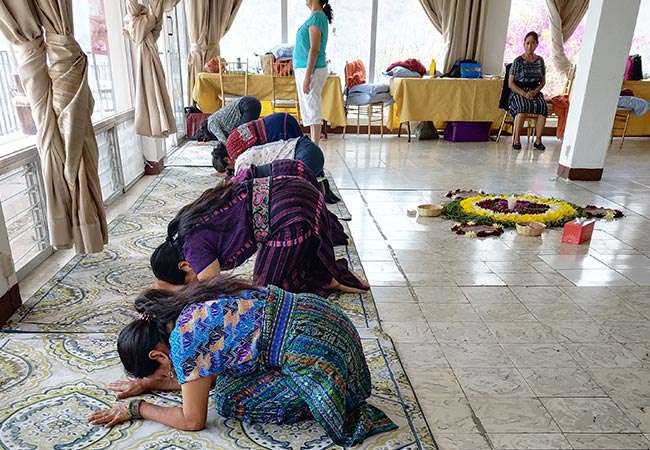
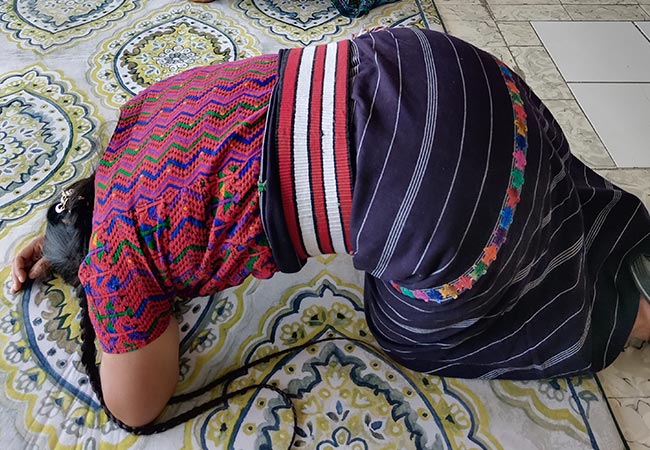
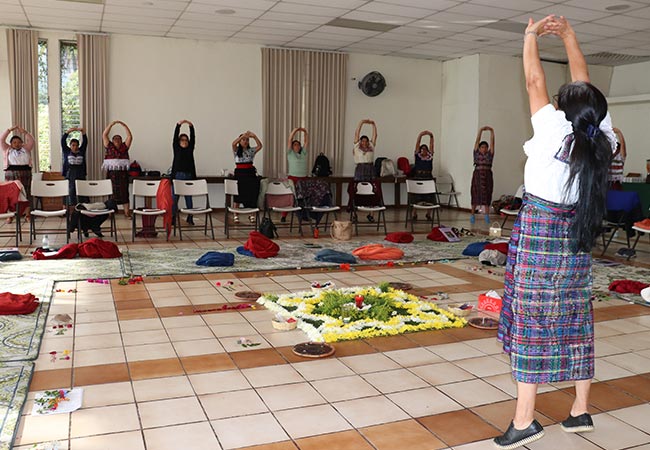
She began working in the Ixil region, where she realised that many communities had been destroyed and massacred during that period. She started working in the social ministry of Quiché, in the mental health programme. The population she served was mostly survivors of the internal armed conflict. For several years, she accompanied relatives of the victims to carry out exhumations, provided psychosocial care and attended to survivors of various forms of violence. However, despite her years of experience, she discovered that she needed to heal the trauma and wounds from her childhood and her journey.
The concept of social therapist
emerged around 2006, based on
the realisation that personal healing
needed to transcend the individual
and extend to the collective, to the community.
In that constant and profound search, she found support from several people who helped her fill the void she said she felt. She was accompanied by churches, priests, nuns, and women leaders from the communities she served. “Before I arrived in Kaqla, I felt empty, I was searching for something to fill me. In the midst of that search, I found part of my mission, which is to enhance my abilities and skills in healing with medicinal plants and to reclaim myself as a healer. There I found part of my path, it filled me up a little, and so I kept walking until I found the wisdom of the great women of Kaqla.”
Since its inception in 1996, the first women of Kaqla accumulated experiences and lessons along the way. The training and healing processes were the foundations of the transformation of those who planted the first seeds. From this process sprang the advances and great achievements of Kaqla as a pioneering healing organisation in Guatemala. The concept of “social therapists” also emerged around 2006, based on the awareness of the need for personal healing to transcend into the collective, into the community.
Social therapists, based on their own healing, contribute to the healing of other people, communities and organisations. According to their energy, possibilities, potentialities and levels of training, they promote healing and training processes in the search for well-being and fulfilment in life. This involves healing, both individually and collectively, the traumas related to oppression, racism, poverty, discrimination and the various forms of violence that affect life. Along this path, Kaqla’s approaches to healing violence are taken into account, as well as the premise that, in order to heal violence and other traumas, it is essential to heal their origin.
In 2016, through the Barbara Ford Association, Sara was invited to get involved in a process and train as a social therapist with Kaqla. “It took me six years to train as a social therapist. I worked on trauma, belief systems and deficiencies, the whole system of oppression that took my eyes off reality. In the process with Kaqla I found my true mission with what I love to do. It vindicated me as a healer, social therapist and traditional healer. I am recognised for the work I do in my community. People seek me out and I feel confident in everything I do. It has allowed me to have a holistic view of the reality of life. This is reflected in my work in natural medicine, healing illnesses from a holistic perspective. I’m incorporating healing tools into my daily work. I have financial independence. Thanks to all these tools, people find hope in life. It has allowed me to contribute to the lives of others by healing them and helping them find balance in their lives and their path, just as I did.
Many of the healing and harmonisation tools acquired by social therapists trained at Kaqla belong to the Mayan culture and worldview. To date, Kaqla has trained nine cohorts of social therapists, including a cohort of men, with approximately 139 people trained. As in Sara’s case, many have enhanced their skills and abilities through the Kaqla processes.
LINKS TO ARTICLES
With FOKUS in Latin America, we’re kicking off the first #FOKUSWeek of the year by sharing part of our therapist training workshop…
Harmony. Equity. Responsibility. Solidarity. Creativity. Positive thinking.
It’s ok to feel fear, anguish, shame, despair, anger, helplessness, or sadness when in a community…
Presentation of Methodological Books developed within the group of the healing and training project for the fullness of life of indigenous women in Guatemala.
A journey toward quality of life. In this video, we present testimonials from some of the participants in the different processes and groups with which Kaqla works.
With the FOKUS in Latin America support, we continue training Social Therapists using Kaqla’s unique methodology.