



CABILDO INDÍGENA DEL RESGUARDO KANKUAMO
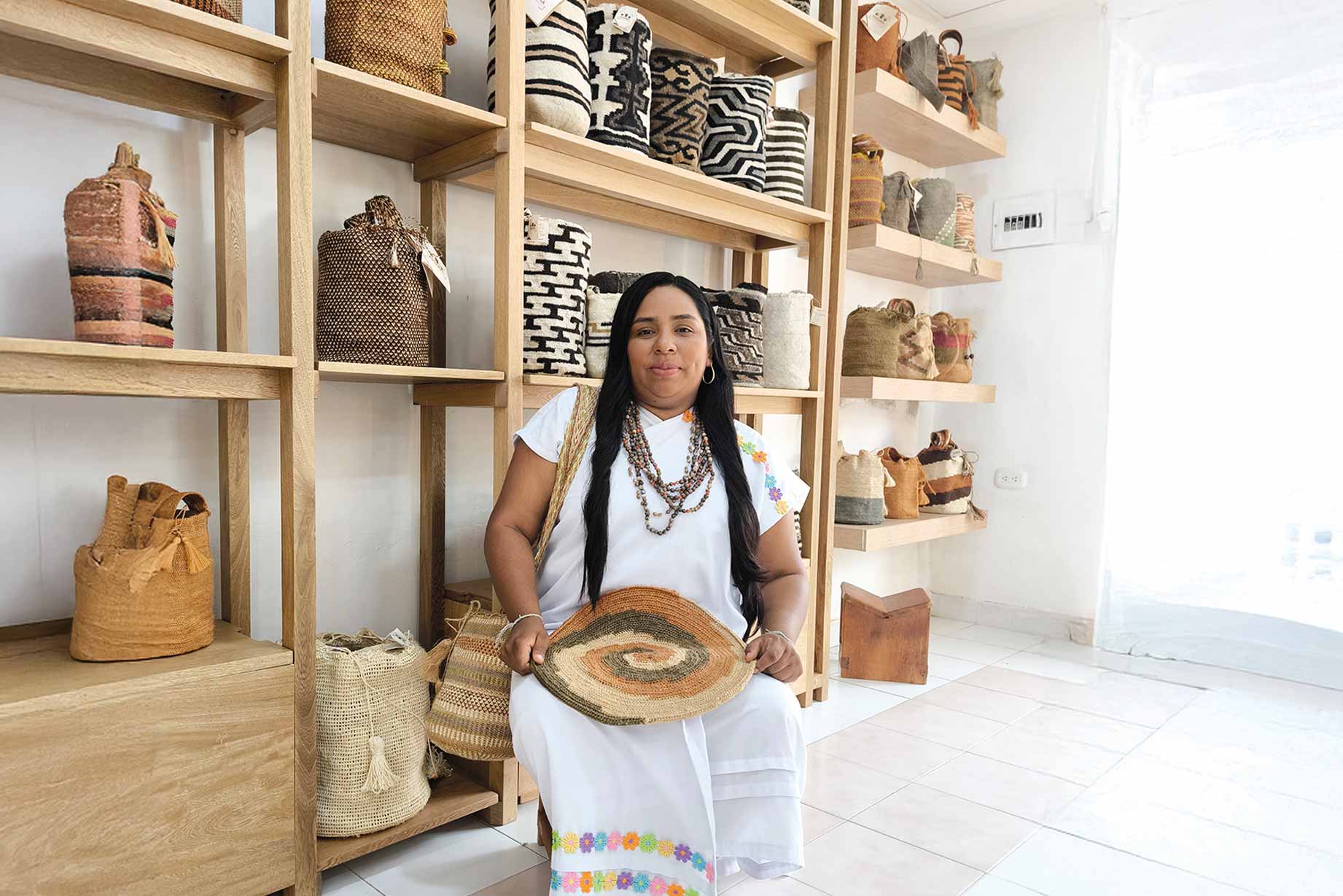
Andrea Marcela Arias, an indigenous Kankuama woman from the Sierra Nevada de Gonawindúa, harmonises and weaves together leadership, healing and ancestry.
Andrea Marcela Arias is an indigenous Kankuama woman born in the community of Chemesquemena in the Sierra Nevada de Gonawindúa. Her path to social leadership began around the age of 14, when she started participating in the Youth Commission. There she discovered her vocation for community work, organisational processes and the well-being of her ancestral people. She enrolled to study sociology. During her third semester she took on the role of coordinator of the Sociology and Legal team, made up of students from various university programs who were working within the framework of the commitment established by the Kankuama authorities for the recovery of the historical memory of the Kankuamo people, weaving together the legacy and invisible stories of their elders. As part of her growth, she participated in the creation of the University Student Council of Indigenous Peoples at the Popular University of Cesar (UPC), which still exists today. In 2015, while in her fifth semester, she became a mother for the first time. Three years later her second daughter was born. Motherhood became a driving force that propelled her to graduate with a degree in sociology in 2019 with a clear vision: “I trained to contribute professionally to the strengthening of my community.” In order to strengthen her leadership, she participates in a programme called “Ethnic Territories” with the Colombian Institute of Family Welfare (ICBF). In addition to this, there was the psychocultural healing process she underwent when she began participating in the Commission of Indigenous Women and Kankuama Families (CMIFAK), after a difficult separation and taking on the upbringing of her daughters. This led her to join the women’s commission as secretary, with the role of promoting tools for resilience, healing and training. This made her realise that her process was not unique since many women were experiencing similar situations of vulnerability in terms of their rights. She therefore decided to join them, accompany them, guide them and grow together on the path towards harmony for Kankuama women and families.
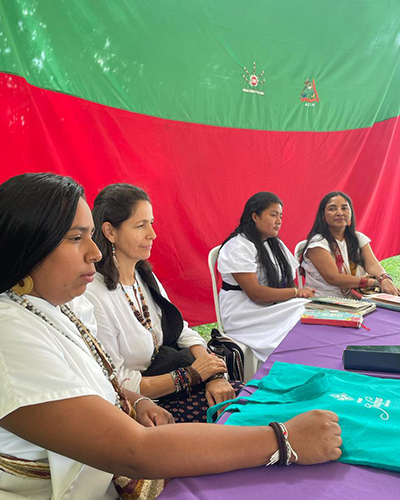
Following that experience she joined the Women’s Community Committee, a space created by CMIFAK to prevent, accompany and monitor access to justice for Kankuama women and families facing violence. This experience began to be shared with other women from the Arhuaco, Wiwa and Kogui indigenous peoples, which led to a twinning arrangement to strengthen each other by establishing that “the women of the Sierra Nevada de Gonawindúa have been valued since ancient times under the Law of Origin and their role is related to the Mother of Origin. From this perspective, it is recognised that what happens to the Mother, to the territory, also happens to women, who share the same effects as any process of harmonisation and healing that is carried out in her favour”.1
“When a woman heals, she can help
heal others. This is how we weave harmony
in the body, the soul and the land.”
This process, called Mochilón de Cabuya de Fique (meaning: big bag woven from natural fique fibre threads), benefited from her contributions and leadership as a strategy for ancestral, cultural, political and pedagogical harmonisation that interweaves the Territory-Body-Memory and proposes an agenda for intercultural peace from the villages of the Sierra Nevada. This deeply spiritual initiative has made it possible to highlight the disharmonies experienced and propose networks of resistance and collective re-existence for the safeguarding and Good Living of its peoples.
During the pandemic in 2020 she joined the Association of Kankuama Women Artisans (ASOARKA), which aims to revive the traditional craft of Kankuamo fique weaving, from planting and processing to marketing the finished products. She has participated in the gathering of memories and the strengthening of ancestral practices through the weaving of bags and hammocks, among other items. She has also contributed to ASOARKA by taking on positions in project management and implementation. In 2021 she formally assumed the position of secretary general of CMIFAK and coordinator of the Observatory on Violence and Disharmony against Kankuamo Women and Families. From there she has been working to promote women’s rights and contributions as indigenous women, their families, the survival of the Kankuamo people and the peoples of the Sierra Nevada. For her, all her leadership is based on this: “Our principle is that every process must be sown from the spiritual realm in order to flourish; it must begin in the soul.” 2
Andrea projects herself as a leader who seeks not only her own well-being, but that of her entire community. To achieve this, she wants to continue weaving paths of harmony, empowering other women, listening to them and accompanying them in their healing and collective processes. That is why she invites “young women to not limit themselves, because we can be mothers, professionals, leaders, healers, we can walk together, weaving community and self-love. Each bag they weave reflects their state of mind. If they are in harmony, that bag will be beautiful, strong and full of meaning. The same is true of their lives. When they heal, they help others to heal. In this collective weaving we leave a better path for our daughters, our mothers and our grandmothers.” She concludes: “I am what I am thanks to the women.” 3
- OIK (2019) Cabuya backpack woven by Women of the Sierra Nevada DE Gonawindúa, ACIN and the Colombian Caribbean. Brochure in Cabuya 3: Women and Cultural Identity.
- Acosta Pimienta Alicia Vanessa. Personal interview with Andrea Marcela Arias. Valledupar, 2025.
- Arias, Andrea Marcela, A.A (10 June 2025). Life Story ‘Andrea Arias’ [Interview].