



CORPORACIÓN ENSAYOS PARA LA PROMOCIÓN DE LA CULTURA POLÍTICA
Interview with the steering committee of the Women Caregivers’ Circles of Northern Cauca.
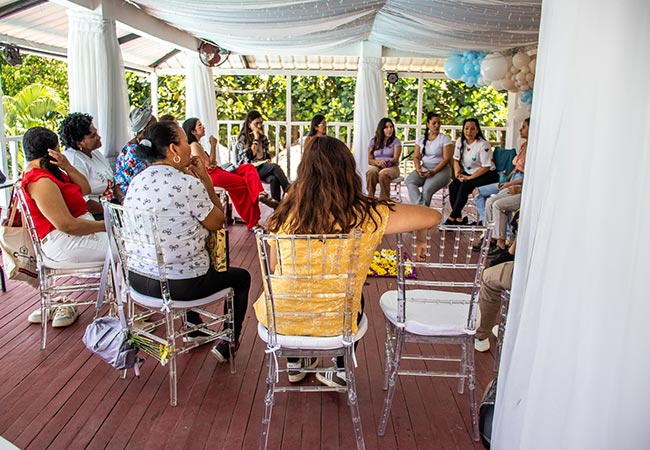
In northern Cauca, a group of Nasa, Black and mestizo women who are signatories of the Peace Agreement, along with LGBTQI+ people, are rethinking care, healing, and reconciliation from a territorial, interethnic, and intercultural feminist perspective.
Corporación Ensayos: How has your perception of care changed since you joined the Circle?
Dielina Palomino: There are many different forms of care. We were used to thinking of care as an everyday activity in our homes, but now we see it as a transformation of our lives and the lives of those around us. That transformation no longer falls on one person, but becomes an exercise in collective action with a sense of good living.
Martha Dagua: Women Caregivers is an exercise in reciprocity. We have received and given. The transformation lies in having the peace of mind to accompany experiences of violence, as well as having the tools to avoid causing harm.
Marcela: We started by shaking off a mandate that was imposed on us: that women are caregivers.
“The Circle is a space where
we can take refuge feel accompanied
and not judged”.
Nelly Paví
Here we ask ourselves about the importance of care for the sustainability of life. This cannot continue to fall solely on us. As this awareness grows, the lives of women and others will improve. This will allow us to move towards the collectivisation of care.
CE: The Circle has been built around the question “who cares for those who care?” How does it feel to be cared for by others?
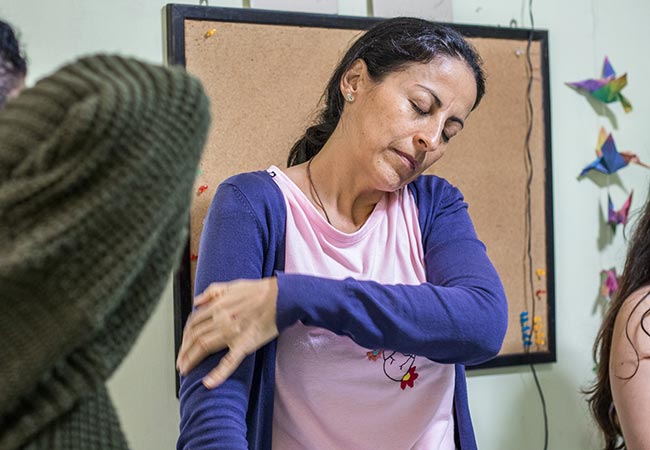
Carmenza: I felt accompanied from the beginning, when we received the marma massage, with the constellations, the psychological accompaniment and the support of our companions. We have felt strengthened by being able to share what is happening to us without being judged. That is what it means to feel accompanied.
Emilse: I am one of the most cared for in this Circle. That care transformed the reality of my life. I was able to look at life with new eyes and it helped me get out of a place I thought I couldn’t get out of.
CE: What do you consider essential for caring for others?
Jessica Llantén: In the psychocultural component we have learned healing techniques and psychological first aid, because each accompaniment is different… In the legal component, instead of answers, questions arise. How do we understand justice and how do we make it restorative? We have learned to think about the relationship between ordinary justice and community justice, but we still have many questions about the institutional obstacles that do not take into account the interethnic and intercultural perspective, which is the emphasis we propose.
CE: What are the main challenges?
Marcela: One challenge is to diversify the commitment to care across generations. The armed conflict in northern Cauca has a generational component that must be understood and addressed. Another is funding. In this regard, what we are seeking in the Circle is to strengthen this feminist, interethnic and intercultural process and show the state the importance of creating public-community alliances that recognise this experience of care in the prevention and response to violence against women and LGBTQI+ people, and that they finance it, always respecting our perspective.
CE: In the face of these challenges, how do you imagine the Circle’s space in the coming years?
Leydi Cuene: I imagine it having its own physical space that provides protection for these sensitive meetings.
Jessika: We want to build a portfolio of services and care. It is important that this Circle reaches more community spaces and other territories, which is why it is important to continue strengthening capacities through training.
Martha: I see it being funded by the state, but not within institutional contexts, because the essence would be lost. Institutions have ways of being and doing things that make any initiative mechanical; it ceases to be profound and humanistic. It would become very technical.
CE: Fokus Magazine also works with women in Guatemala and other parts of Colombia. What message would you like to send them?
Dielina: We must weave together. We must share our experiences. We have gained knowledge that we can share with other people who are doing the same thing in other parts of the world. We can enrich others and ourselves from these experiences that have situated realities.
Marcela: Internationally, there is an exacerbation of warrior masculinities. It is a threat that highlights a setback in the rights of women and LGBTQI+ people. The call is to internationalise these feminist commitments: territorial, inter-ethnic and intercultural, to find ourselves with others. We must return to the principle of international solidarity in these struggles.
Martha: We need to reinvigorate these policies to put carers at the centre of all these conversations and dynamics. These initiatives are political and poetic; the reality is that carers must be at the centre.