



COMUNIDAD DE JURISTAS AKUBADAURA
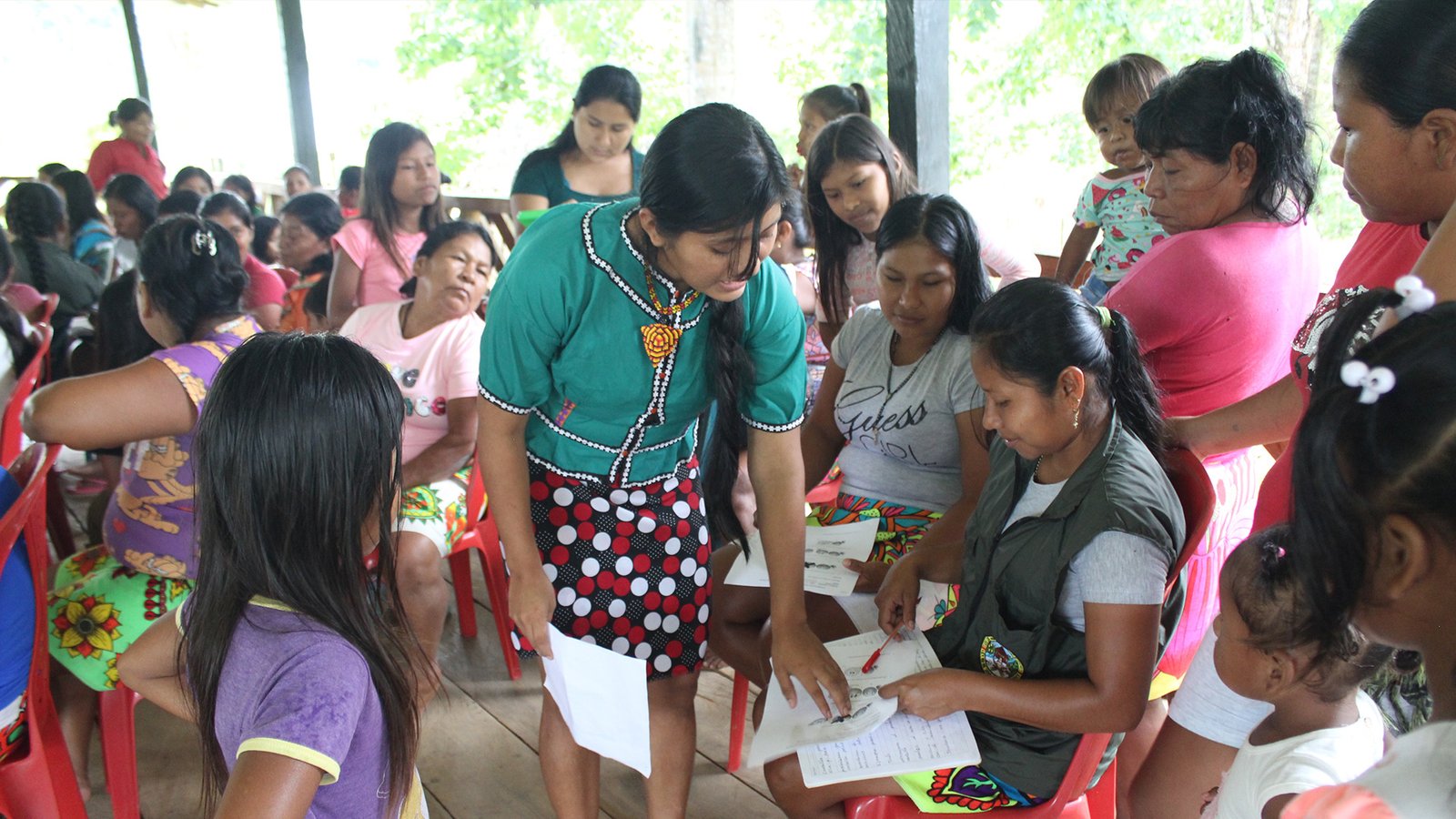
Nepono Carupia, a young Emberá woman who overcame her shyness to become a workshop leader, now brings joy to her community by teaching that women’s worth knows no limits or boundaries.
At Akubadaura, we spoke with Nepono Carupia Domicó, a 25-year-old Emberá Eyábida woman. Although the conflict displaced her as a child, her voice remains deeply rooted in her native Chidima Tolo reserve (Acandí, Chocó). After training with Akubadaura – and with the support of FOKUS – in human rights and communication, she overcame her shyness and has been leading workshops in her own language since 2021. She discovered her ability to guide others, and today it fills her with joy to see how young women want to learn more and speak out for their rights.
Comunidad de Juristas Akubadaura: What was your level of confidence like before this process, and how much did you know about the training topics?
Nepono Carupia Domicó: Not in depth, just a general idea of what one heard about rights – that was about it.
CJA: Which aspects of the process have had the greatest impact on you?
“Many of us used to think that
physical and psychological violence
was normal, but not anymore.
Those women no longer put
up with being hit. Now they’re
speaking out.”
NCD: Fundamental rights. I’m happy when we’re invited to take part in meetings. Learning about our rights – and especially as Indigenous women – knowing that we have the same rights as men when it comes to gender equality. Some of the women we spoke to said that you learn things this way, just like at school, as if you were going to school every day and something is bound to stick in your mind – and Akubadaura did just that.
CJA: Thinking about the community, what has been the greatest benefit of the training and who else has benefited?
NCD: The benefit is that women now have the capacity to support both men and women equally, and to demand their rights from the institutions and the de facto indigenous authorities; and I believe the women have benefited the most. Before I came, I met with a group of women and they said: ‘Tell them not to leave us on our own but to keep supporting us, to keep running workshops in the communities and across the territories so that more women can be trained and we can fight together for our cause, for our territory.’ Continuing to work on human and territorial rights is absolutely vital for us.
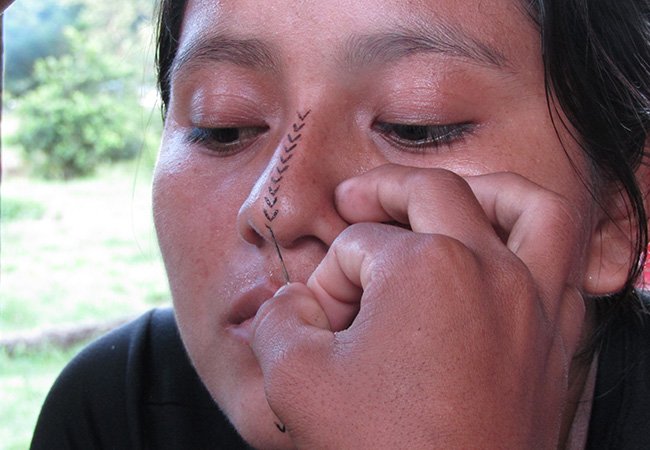
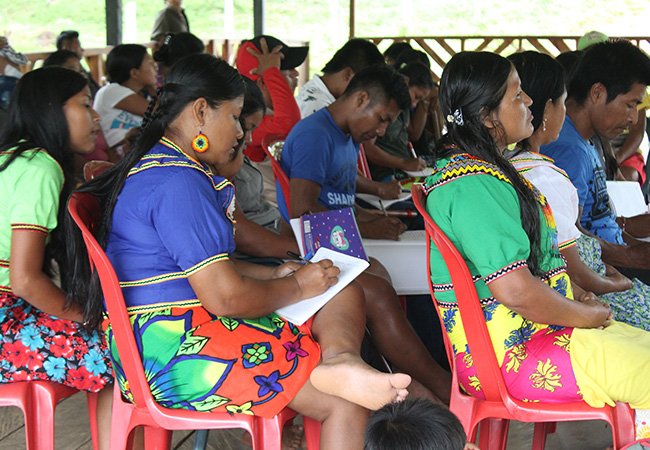
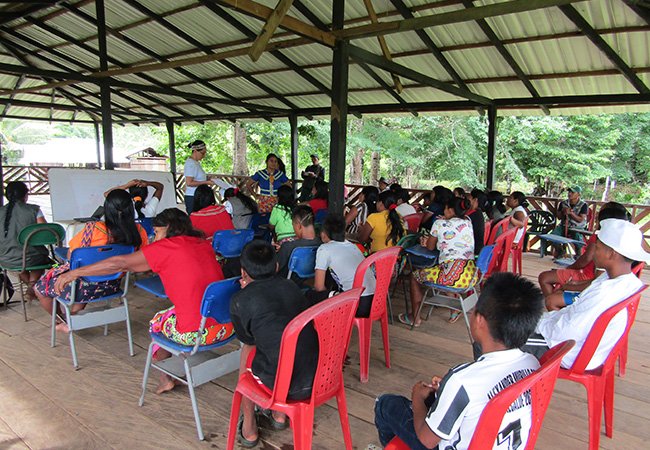
Nepono Carupia leads a workshop in Acandí, Chocó.
CJA: How did this process affect the work of the Indigenous authorities?
NCD: It was important that the authorities took part in this process, because we believe that men and women complement one another. It was important for the men to be there, because it is no use if only women receive training. If the men attend and hear everything that is happening or come to understand our value, they will recognise us within the community. It is the men who administer justice, and as they were present throughout this process, it reinforced the idea that there must be equality in the administration of justice. I have seen that, in my own community for example, there are more men standing up for women, because previously that was unheard of.
CJA: Do you feel that a path has been paved to prevent violence in the area?
NCD: ery much so. Many of us used to believe that physical and psychological violence was normal, and we normalised it, but not anymore. I can see that these women no longer let themselves be hit. They are now the ones speaking out and demanding that their rights be respected, so they have contributed enormously. I’ve noticed that men now carry their children – you never used to see that. Now they’re the ones walking around with babies in their arms, saying, ‘Well, he’s my son and I have every right to carry him, to look after him too, and to stay at home with him whilst my wife is on a training course’.
CJA: When did this change in men start to become noticeable?
NCD: ’d say it started when you arrived. I’ve spoken at community meetings. There people say, ‘this is right’ or ‘this is wrong’, and now I feel able to stand up for a woman – for example, when she’s suffering some kind of violence – I don’t stay silent. Precisely because of that, you know that not everyone understands this or values women, and so there have been clashes, but as one is now familiar with these issues, one can speak up without hesitation.
CJA: What would it take for a woman from the community to become governor?
NCD: I think she’d need to demonstrate the ability to speak in public, to tackle issues relating to any kind of violence or insecurity. Also, with regard to the armed conflict, for us women to know how to defend ourselves.
CJA: What are you studying and what motivated you to do so?
NCD: Early childhood education. It’s about learning how to use strategies for all these things, knowing how to get more women involved in training programmes on human rights, communication, what’s appropriate… that’s what it’s for.
CJA: To conclude, looking back, what has shaped your life and what does this journey mean to you on a personal level?
NCD: Personal and mental growth. I no longer think the same way I used to about the importance of women in indigenous communities. We have value, we have a voice and a say in the community without fear of being told that it’s not ok. For me, it’s been important because I’ve gained new knowledge and learnt to share it. I recognise my leadership and teach other women based on what I’ve learnt. I think there’s a sense of empowerment from the role models among indigenous women, and you find yourself thinking: ‘I too believe that one day I’ll reach that level’.