



In the mountains of Sogamoso, in the heart of the Boyacá highlands, a voice resounds with strength, empathy and purpose.
Andrea Amaya, nurse, mother and leader of the MADERA Project (Women Allied for their Reproductive Rights and Autonomy), embodies a struggle that goes far beyond medical care. She defends the right of women, young people and sexual minorities to make decisions about their bodies, lives and futures.
“I am the mother of a two-year-old girl. I work in sexual and reproductive health, and I see first-hand how the lack of comprehensive sexuality education and access to services deeply affects our communities.” Andrea emphasises that her work is not exclusively technical, but rather a mission born out of the recognition of injustice and the desire to change the current indicators in her department. There are still “girls who are pregnant, women who are judged, health professionals who are poorly trained and communities that are mired in myths, taboos and prejudices.”
Fundación Oriéntame: What need did you identify in your community that led you to become a leader?
Andrea Amaya: “Every day I see how ignorance about sexual and reproductive rights impacts people’s lives,” says Andrea. Women who are judged, pregnant girls, uninformed health professionals and communities trapped in taboos and prejudices: “this is the context that gave political meaning and urgency to my work”.
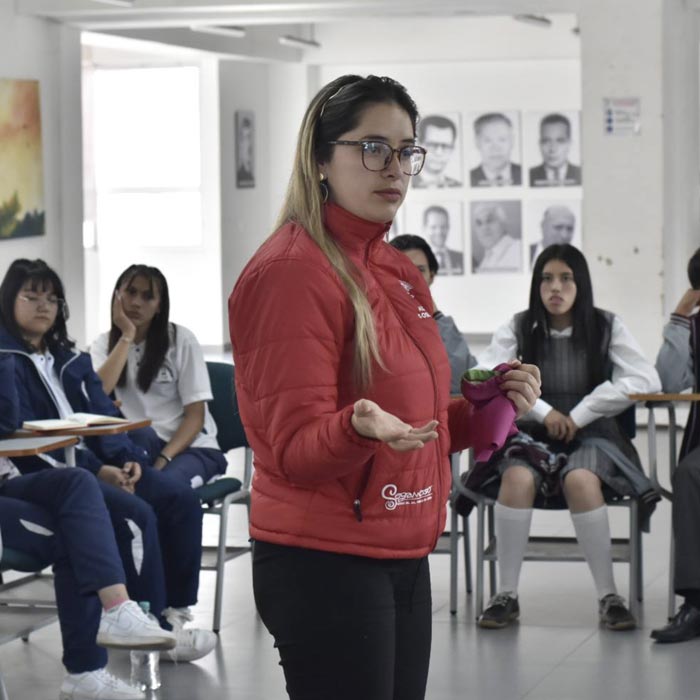
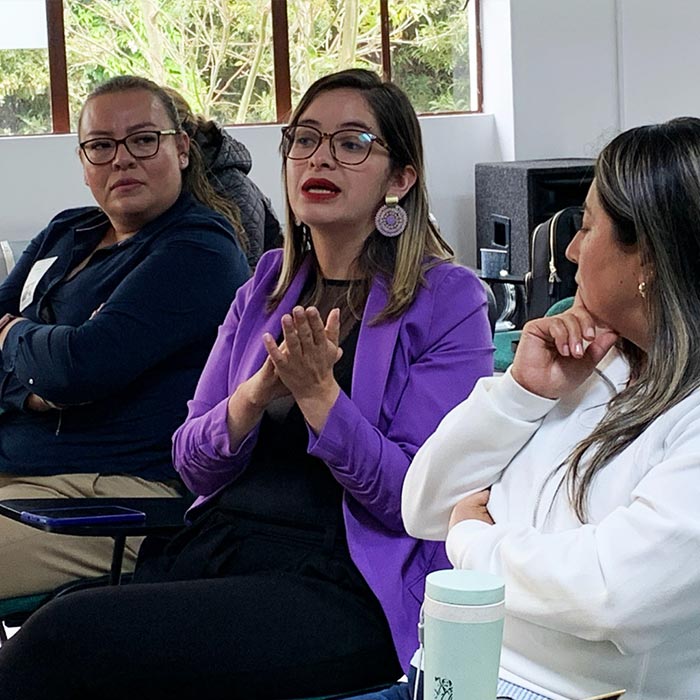
FO: Was there a moment that marked a turning point in your decision to take action?
AA: In December 2023, “an eleven-year-old girl disappeared and was later found dead. Her death shook not only the municipality, but the entire country. For me, it was a painful but urgent call to action.” This event became a rallying cry for Andrea, who has turned knowledge into a form of resistance. Since then, her work has intensified in training, awareness-raising and advocacy spaces, both in public and private settings. “People think that talking about sex education is talking about promiscuity, but it’s quite the opposite,” she says. “It’s about rights, care and dignity.”
FO: How has the experience of training others been for you?
AA: Each training process has also been a transformative experience. “In each workshop, I not only share knowledge: I learn, listen and understand better how to communicate with people.” What strikes her most is the genuine desire of many people, especially young people. “There is fear, there is guilt, but there is also a lot of curiosity,” she says.
“I want us to be
a proactive community,
not a reactive one,
moving from
misinformation to
conversation, from
silence to action.”
In her work as a trainer in the village of El Pino, in the municipality of Sogamoso, Andrea has found that transforming collective imaginaries is a slow and challenging process. “Many issues, such as voluntary termination of pregnancy, continue to generate strong resistance,” she says. That is why she is firmly committed to making comprehensive sex education a reality in her community. A continuous education without taboos, adapted to each stage of life—from early childhood to late adulthood—that promotes knowledge of the body, respect for autonomy and the informed exercise of rights.
FO: What is your dream for your community in terms of sexual and reproductive rights?
AA: Andrea imagines a fully informed community where sexual and reproductive rights are understood as an essential part of social justice and personal autonomy. Beyond education, she dreams of universal access to sexual and reproductive health services of good quality: a comprehensive care that is confidential and free of barriers and stigma. In her vision, sexual and gender diversity must be recognised, valued and respected in all spaces. “I want us to be a proactive community, not a reactive one, moving from misinformation to conversation, from silence to action,” she says.
FO: What have been the main challenges or barriers on your journey as a leader?
AA: In times of fundamentalist discourse, legislative setbacks and invisible barriers, “the greatest resistance often comes from the institutions themselves”; religious prejudices, social stigmas and even misinformation among health teams hinder her work. In response, she is committed to ongoing training, alliances with committed institutions and sustained community work.
FO: If you could leave a message or a wish for your community and for other women who want to work for their rights, what would you say?
AA: In a country like Colombia, where sexual and reproductive rights remain a battleground, Andrea Amaya reminds us that “bodies and lives matter.” Community leaders are a beacon in the midst of the silence. The revolution of dignity is sown step by step, with tenderness, firmness and memory. That is why her advice is emphatic: “Trust your voice.”
Her call to inform, educate, dialogue and act runs through all her work. As she herself puts it: “It’s not about grand gestures, but about sowing awareness little by little. No one transforms anything alone: build networks and persevere.” Andrea sows a feminist pedagogy that challenges mandates, transforms bodies and ignites convictions. Because, as she says, “change begins when a community decides not to remain silent.”